Class Details
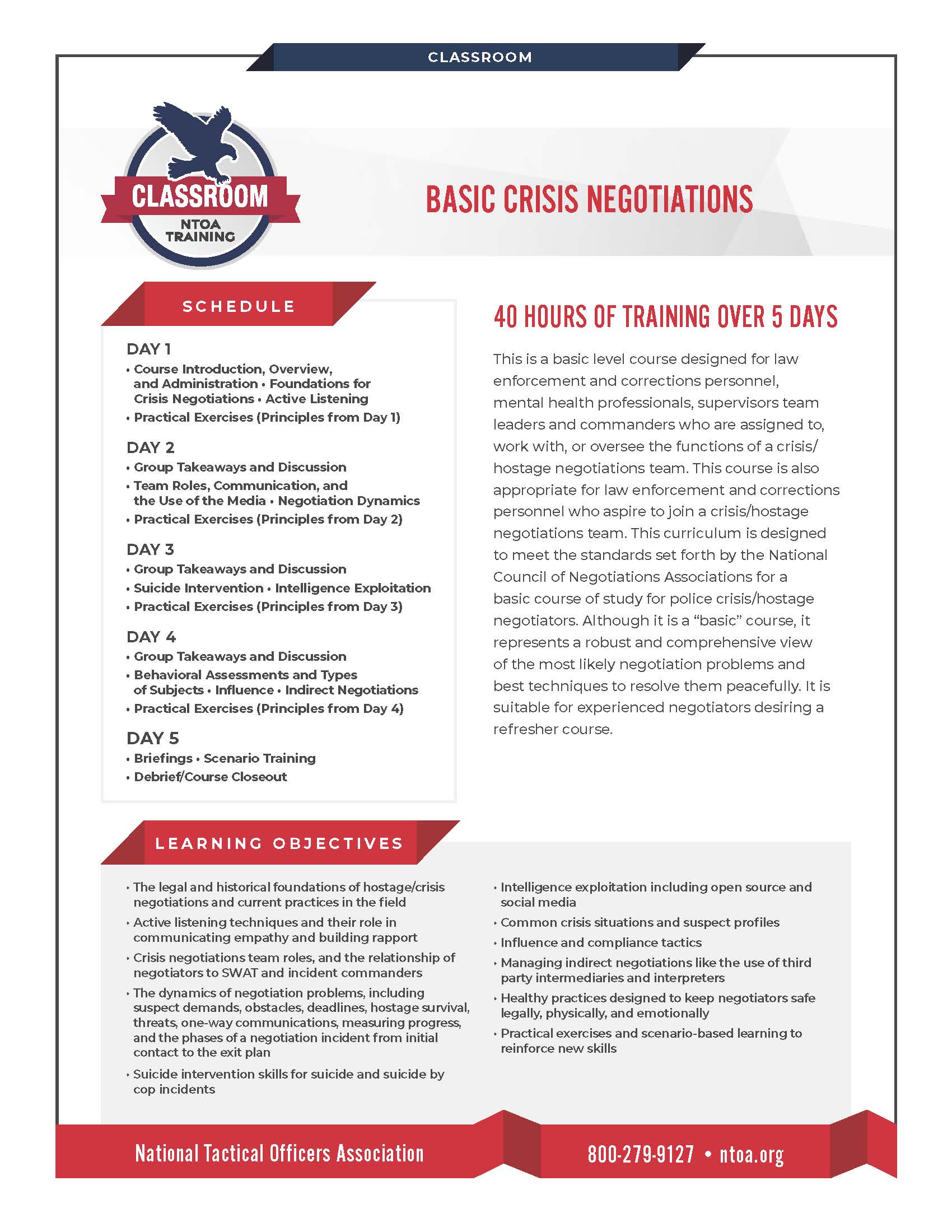
This is a basic level course designed for law enforcement and corrections personnel, mental health professionals, supervisors team leaders and commanders who are assigned to, work with, or oversee the functions of a crisis/hostage negotiations team. This course is also appropriate for law enforcement and corrections personnel who aspire to join a crisis/hostage negotiations team. This curriculum is designed to meet the standards set forth by the National Council of Negotiations Associations for a basic course of study for police crisis/hostage negotiators. Although it is a “basic” course, it represents a robust and comprehensive view of the most likely negotiation problems and best techniques to resolve them peacefully. It is suitable for experienced negotiators desiring a refresher course.
INSTRUCTIONAL GOALS
Upon completion of this course the attendee will be familiar with:
1. The legal and historical foundations of hostage/crisis negotiations and current practices in the field
2. Active listening techniques and their role in communicating empathy and building rapport
3. Crisis negotiations team roles, and the relationship of negotiators to SWAT and incident commanders
4. The dynamics of negotiation problems, including suspect demands, obstacles, deadlines, hostage survival,
threats, one-way communications, measuring progress, and the phases of a negotiation incident from initial
contact to the exit plan
5. Suicide intervention skills for suicide and suicide by cop incidents
6. Intelligence exploitation including open source and social media
7. Common crisis situations and suspect profiles
8. Influence and compliance tactics
9. Managing indirect negotiations like the use of third party intermediaries and interpreters
10. Healthy practices designed to keep negotiators safe legally, physically, and emotionally
11. Practical exercises and scenario-based learning to reinforce new skills
Registration
- Fee: $746-Members / $801 - Non-Members
- Deadline: March 6, 2026
Prerequisites
Sworn law enforcement, fire/EMS, 911 dispatchers, corrections, mental health professionals
Student Needs
• Law Enforcement I. D.
• This course is conducted entirely in the classroom
• Laptop is helpful to the student, but not mandatory (student notebooks will be made available via Dropbox)
• Business casual dress may be worn